


Clean air - is it fair?
- Zoe Head-Thomas

- 11 févr. 2023
- 4 min de lecture
Dernière mise à jour : 21 févr. 2023
Most polluting commercial vehicles will soon have to pay a fare for travelling through Sheffield city centre, now known as the Clean Air Zone.
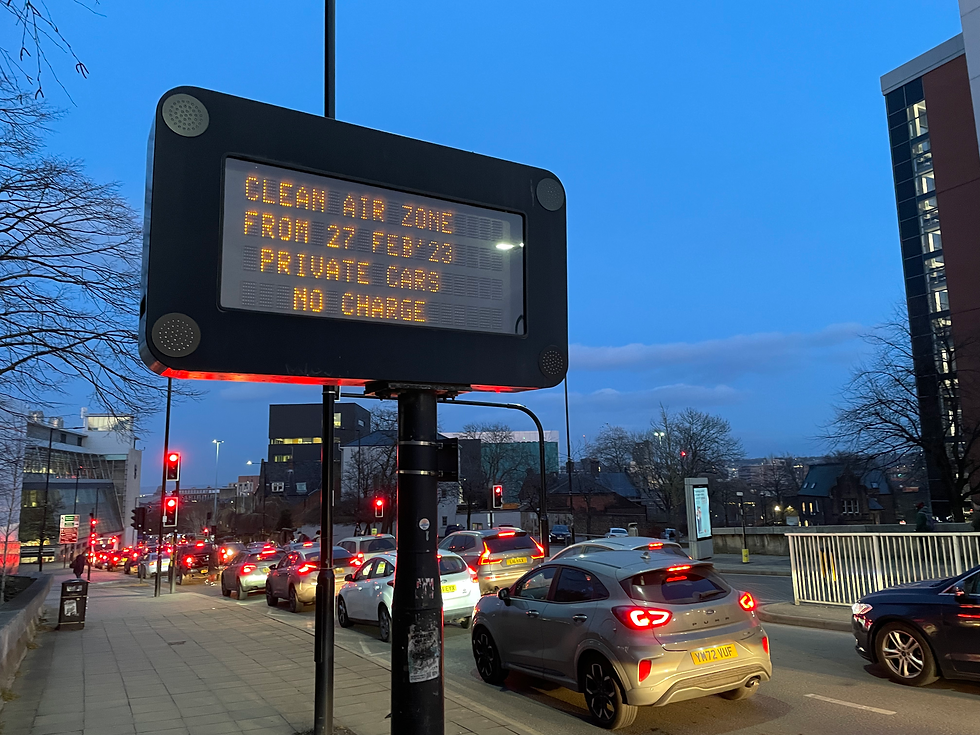
You may have seen signposts throughout the city of Sheffield of a so-called Clean Air Zone, but who really knows what it means?
As the name suggests, it aims to provide cleaner air, and does so by targeting and limiting pollution. The system already exists in other cities around the UK such as London and Bradford.
Although they don’t all work in the same way, Clean Air Zones, commonly known as CAZ, all have the same objective set out by the government’s Clean Air Strategy. Different zones were given different targets. For Sheffield, this target is ranked C, meaning it will affect high pollutant commercial vehicles only.
Sheffield’s CAZ will be contained within the ring road; the zone that covers the whole city centre and runs between Broomhall, Kelham Island and the train station.
Frank Hayes, owner of Sheffield Motorcycle Centre (SMC Bikes) has been running his motorcycle shop and training up employees since 2000. He is one of the many people soon to be affected by the Clean Air Zone.
Just like other small business owners in the city centre and within the new Clean Air Zone, Mr Hayes relies heavily on deliveries and larger vehicles for the transport of goods. When he makes a bike sale, the bike is delivered directly to the customer's house. The CAZ will therefore affect him and his staff.
As the council details, from February 27th, HGVs (heavy goods vehicles), LGVs (large goods vehicles), vans, buses, coaches and taxis will have to fit specific requirements set out on their website or they will face a fine. For a van, LGV or taxi, the fine is £10 a day, while the charge is £50 a day for a coach, bus, lorry or HGV.
It leaves Mr Hayes with a choice: to pay the penalty charge daily, or to invest in a new delivery vehicle. This difficult decision seems to particularly affect small businesses who are already struggling with the cost of living crisis.
Mr Hayes has already been suffering the consequences before the scheme has even started. Some of his skilled and experienced technicians have left the job, worried they could not afford to buy a new van. He said, “They also cannot afford to come into work each day and pay £10 for this privilege so they are gone, I have lost them. I have now got one qualified technician left.”
The Clean Air Zone only affects commercial vehicles, not private cars. Residents will still be allowed to drive through the city centre without being charged, even if their vehicle is considered a high pollutant, as long as it isn’t commercial.
For resident and business owner Vicky Coates, 55, this rule is a problem. She uses her vehicle for private and commercial purposes in equal measure.
As her van is registered as a business vehicle, however, she will not only be affected in her work but also her personal life. Ms Coates said, “We use the van for everything: shopping, theatre and meals out in town in the evening, journeys to the train station for my work.
“My wholesalers are on the parkway and there is no other way to get there than over the roundabout that’s also included in the CAZ.”
Sheffield is a city widely spread, with a relatively small city centre compared to its almost 600 000 inhabitants. The centre is known for having deteriorated over the years, with other areas such as Kelham Island or the shopping centre Meadowhall gaining in popularity.
Ms Coates struggles to understand the council’s decision to create this zone. She said “I go through the centre every day for work, and it’s already a ghost town.”
Added to that is the worry that deterring high polluting vehicles from the Clean Air Zone could displace the issue. Co-chair of Sheffield Tree Action Group Jon Johnson, said as a business owner “this zone will just move polluting vehicles into smaller streets and residential areas.”
Although highly criticised by local businesses, Julie Grocutt, Co-Chair of the Transport, Regeneration and Climate Policy Committee, assured this decision was not the council’s to make. It rather came from a wider government scheme to keep pollution levels stable in cities across the country.
According to Ms Grocutt, £20 million of funding from the government is available for people to either buy newer vehicles or to retrofit their existing ones. The problem is that those concerned seem unaware of financial support available to them.
Ms Grocutt added that extensions were available to allow more time for people to find a solution. Those granted an extension have until June 5th.
She said “success to me is no one paying the charge in Sheffield because that means people have taken advantage of the funding and are using that to make sure that their vehicles are compliant.
“I would urge anyone who has a licensed vehicle to check on the government website if their vehicle is compliant or not - if it is not, to go on the links to apply for the grants that are available.”
Board member of the South Yorkshire Climate Alliance, Lindy Stone, assures this is the only way to get pollution levels down in Sheffield. She said, “Unlike other cities such as Leeds, Sheffield has not taken steps to reduce pollution levels.
“Leeds was able to put its Clean Air Zone plans on pause because measures were taken; they switched to electric buses.”
Commercial vehicles have until Monday 27th of February to upgrade unfit vehicles, or they will be charged for driving through the Clean Air Zone.
Feature written as part of a multimedia group project.


Commentaires